Timing & Light
Sunrise vs Sunset at Mount Fuji: Which Is Better for a Proposal?
A complete comparison based on visibility, crowds, atmosphere, and emotional experience — not Instagram assumptions.
Timing & Light
A complete comparison based on visibility, crowds, atmosphere, and emotional experience — not Instagram assumptions.
One of the first — and most important — questions couples ask when planning a proposal at Mount Fuji is simple:
"Should I propose at sunrise or sunset?"
On the surface, both sound romantic. In reality, the difference between sunrise and sunset at Mount Fuji can completely change:
There is no universally "correct" answer — but there is a better choice depending on what kind of moment you want to create.
This guide breaks down the real differences between sunrise and sunset proposals at Mount Fuji, based on on-the-ground experience, not Instagram assumptions.
Section 1
Many couples spend weeks choosing the "perfect" proposal location — and only minutes thinking about timing.
At Mount Fuji, timing affects:
A beautiful location at the wrong time can feel:
Whereas a simple location at the right time can feel:
This is why professional proposal planning always starts with time of day first, location second.
Section 2
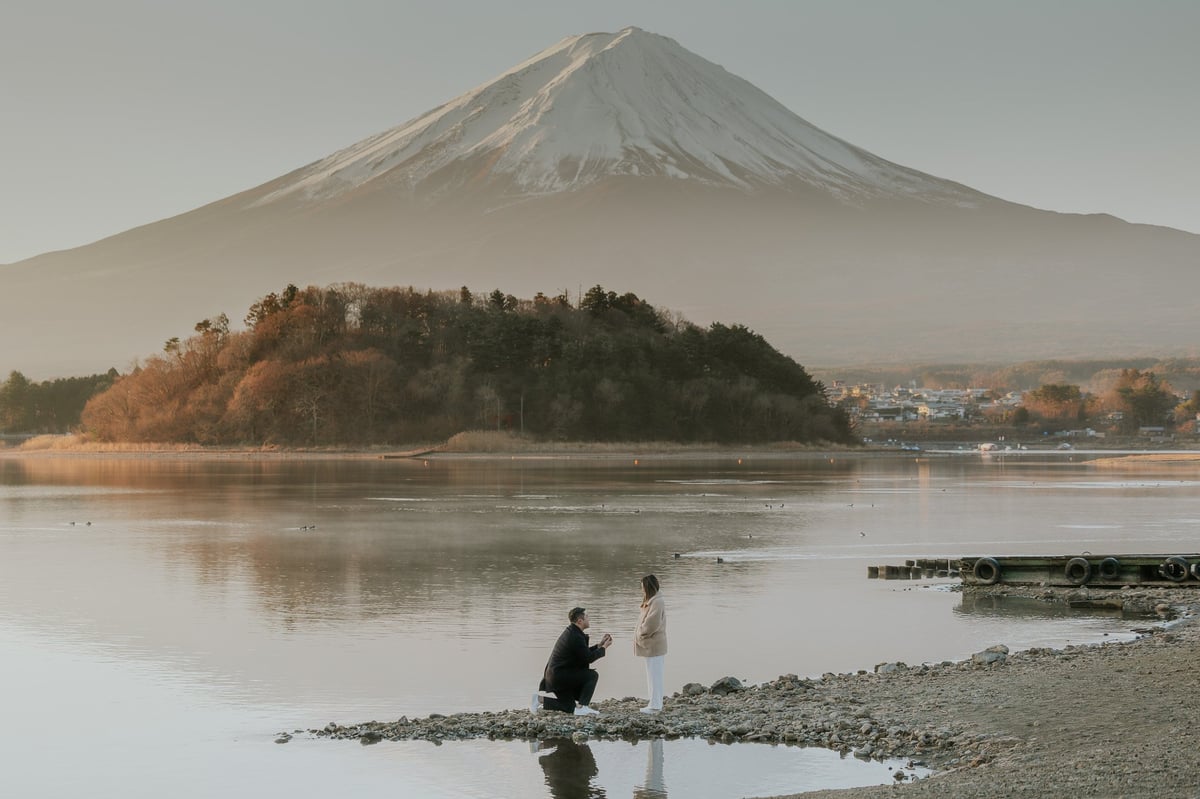
Sunrise at Mount Fuji feels very different from the rest of the day.
In the early morning:
For many couples, this atmosphere creates a deeper emotional connection.
There's no rush.
No audience.
Just the two of you — and the mountain.
Statistically, early morning offers:
While visibility can never be guaranteed, sunrise consistently offers the best odds of seeing Mount Fuji clearly.
This is especially important for proposals, where disappointment can feel heavier than during a casual photoshoot.
Sunrise light is:
It's extremely flattering for photography and creates a natural, cinematic look without harsh shadows.
This makes sunrise ideal for:
Sunrise proposals are ideal if:
This timing pairs perfectly with curated experiences such as Fuji First Light, which are designed specifically around early morning conditions.
Learn more on the Mt. Fuji Proposal Experiences page.
Section 3
Sunset has a very different energy.
As the day progresses:
For some couples, this feels exciting and romantic. For others, it feels distracting.
Sunset proposals can still be beautiful — but they require the right expectations.
As the day goes on:
This doesn't mean sunset proposals always fail — but they come with more uncertainty.
Couples choosing sunset should be comfortable with:
Sunset light can be stunning, but it:
Proposals that run late may:
This is why sunset proposals require strong coordination and pacing.
Sunset proposals are ideal if:
Sunset can work beautifully — but it's not for everyone.
Section 4
Online photos rarely show:
Crowd levels vary dramatically by time of day.
If privacy matters to you, sunrise is usually the safer choice.
You can see real examples of crowd differences in the Gallery.
Section 5
This is the part most blogs ignore.
Couples often describe sunrise proposals as:
"Peaceful"
"Surreal"
"Just us"
Some couples love this energy.
Others feel distracted by it.
The right choice depends entirely on your partner's personality.
Section 6
Proposal flow refers to how naturally the moment unfolds.
For first-time proposers, sunrise tends to feel less stressful.
Section 7
Sunrise vs Sunset changes by season.
Seasonal planning plays a huge role in deciding the best time.
Section 8
MYTH
"Sunrise is too early and not romantic."
REALITY
Many couples describe it as the most emotional part of their trip.
MYTH
"Sunrise photos look dark."
REALITY
Early morning light is soft and flattering.
MYTH
"Sunrise is only for photographers."
REALITY
It's often the most comfortable time for proposals.
Section 9
Neither choice is wrong — but one will usually fit your relationship better.
This is why guided planning matters more than copying what you see online.
Learn how planning works on the How It Works page.
Section 10
The best Mount Fuji proposals aren't defined by the time on the clock.
They're defined by:
When timing aligns with intention, the proposal becomes unforgettable.
If you're planning a proposal and want guidance based on real conditions and experience, your details will be reviewed carefully, and the most suitable timing and experience will be recommended.
Request AvailabilityContinue Reading